2026: the International Year of Volunteers for Sustainable Development.
Each Habitat affiliate is a part of global efforts to achieve the Sustainable Development Goals.
The United Nations General Assembly has proclaimed 2026 the International Year of Volunteers for Sustainable Development. 2026 marks 25 years since the first UN International Year of Volunteers in 2001. The purpose of the year is to recognize, promote, and amplify the vital role of volunteerism in achieving the Sustainable Development Goals (SDGs) by 2030, and to urge governments and organizations to integrate volunteerism into policies and strategies.
Each Habitat for Humanity affiliate is a part of the worldwide effort, undertaken by various organizations and governments, to achieve the SDGs. What are they?
In 2015, 193 national governments from all around the world came together at the United Nations and adopted the 2030 Agenda for Sustainable Development — also known as the Sustainable Development Goals — to address human, community and environmental challenges faced globally, and to encourage an intersectional approach. This collection of 17 goals and 169 targets forms a framework to guide global action that help people and our environment, and to encourage collaboration among initiatives in pursuit of these goals.
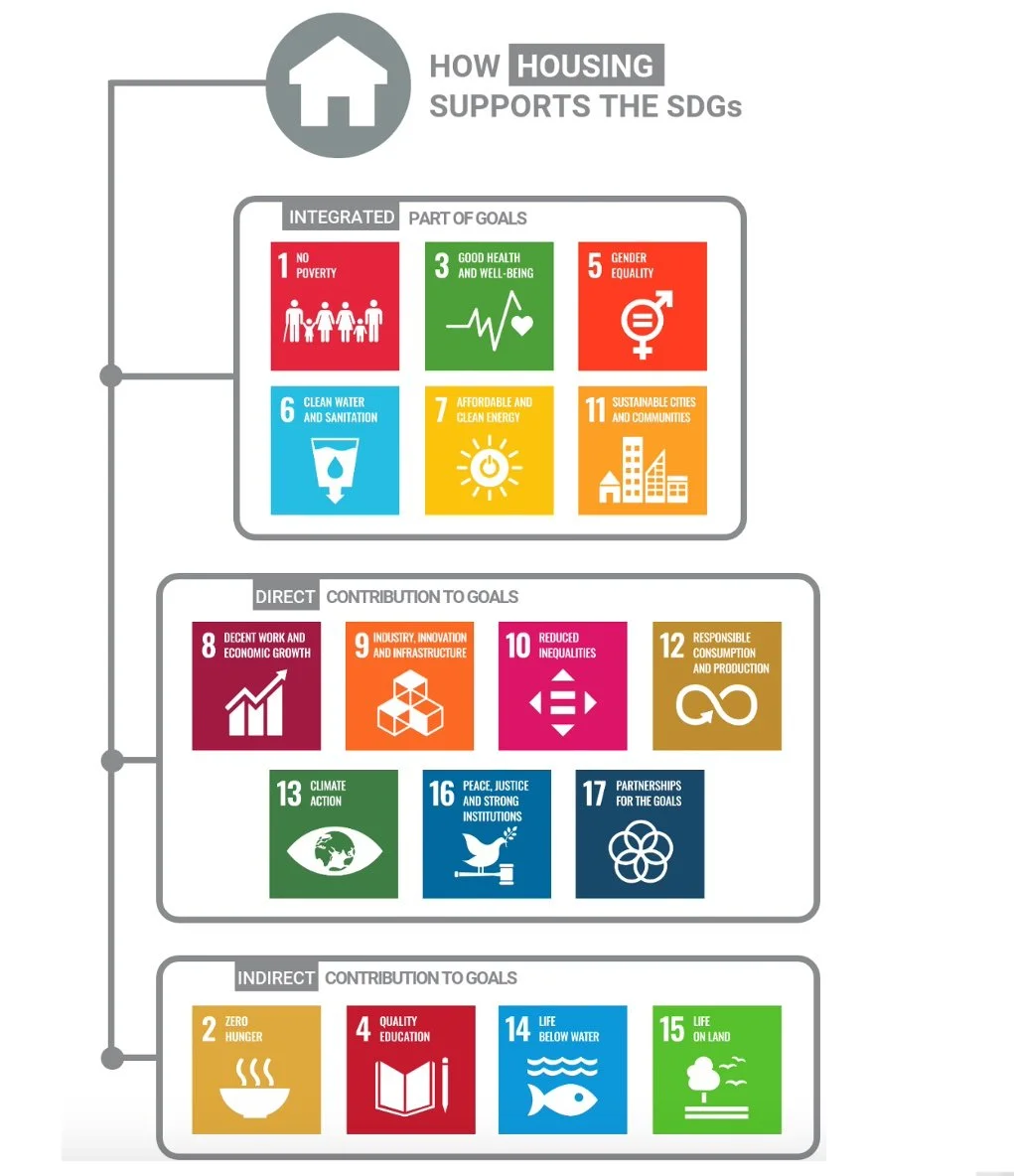
The work of Habitat for Humanity contributes to many of these SDGs, such as SDG 10, with a goal of reducing inequality, and SDG 3, with the goal to ensure healthy lives and promote well-being for all at all ages. Actions toward adequate and affordable housing have multiple effects, as is frequently noted in Habitat materials, like improved health outcomes, improved education for children and improved safety and security. The graphic on this page, by Nóra Feldmár, is a terrific illustration of how housing directly and indirectly contributes to the SDGs.
SDG 11, in particular, is one that Habitat International makes a priority: it aims to make cities and human settlements inclusive, safe, resilient and sustainable.
It’s projected that by 2050, two-thirds of humanity — 6.5 billion people — will be living in urbansettings, especially in the developing world. Governments cannot achieve sustainability without significantly transforming the way we build and manage our urban spaces. To address this reality, Habitat advocates for and supports commitments to SDG 11 and its targets. Specifically of note is target 11.1:
By 2030, ensure access for all to adequate, safe and affordable housing and basic services and upgrade slums. Integrated housing frameworks support economic, social and environmental policy planning and infrastructure linkages across the urban-rural ecosystem, building increased resiliency.
To achieve SDG 11 by 2030, all stakeholders must work together to find success. That’s why Habitat for Humanity engages the U.N., local and regional governments and civil society organizations to play a role in supporting commitments to this target.
You can read more about the work of Habitat for Humanity International and its commitment SDG 11 here.
You can read more about Habitat for Humanity and how it works towards all the SDGs in this PDF file.
When you see representatives of West Tuality Habitat engaging in advocacy efforts, such as meeting with elected officials and people administering government programs at the city, county, regional, state and even national level, collaborating with other nonprofits in our area, and attending events by other organizations, know that we’re doing this because it both makes our own work stronger and also contributes to collective efforts to address the most critical issues facing people and our environment.
West Tuality Habitat for Humanity joins other Habitat affiliations around the world in emphasizing the essential nature of engaging volunteers in our work and collaborating with our communities to make home ownership more affordable and accessible for all. Join us as a volunteer and consider supporting our work with a financial gift.